
Are Dental Implants Worth It Compared to Bridges or Dentures?

When you're looking into replacing missing teeth, the difference in cost between dental implants, bridges, and dentures can be substantial.
It's natural to wonder what you're actually getting for the extra investment. Will implants make eating easier? Will they last longer? Is going through surgery really necessary when other options are available?
For many patients, dental implants are worth considering because they provide stable support for replacement teeth, help preserve the surrounding jawbone, and can offer long-term functional benefits.
However, they're not automatically the best choice for everyone. Your oral health, budget, treatment preferences, and the number of teeth you're missing all matter.
How Do Dental Implants, Bridges, and Dentures Compare?
The biggest difference between these options is how the replacement teeth are supported.
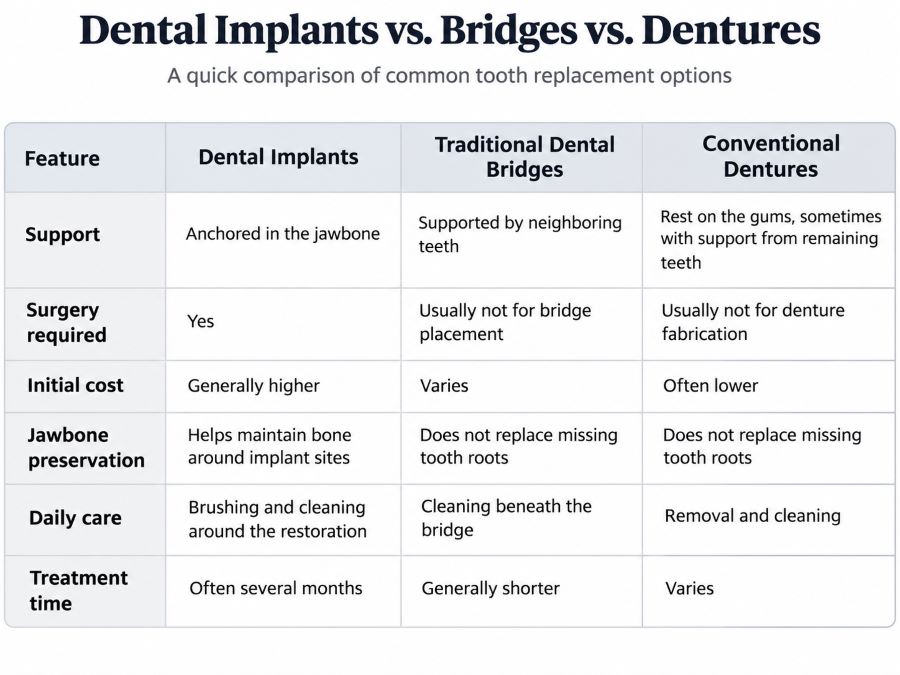
Each option can restore missing teeth, but the experience of living with that replacement can be quite different.
What Are You Paying for When You Choose Dental Implants?
With a traditional bridge or denture, the treatment primarily replaces the visible portion of your missing teeth.
A dental implant replaces the root as well.
The implant is surgically placed into the jawbone, where it provides a foundation for a crown, bridge, or denture.
This additional step helps explain why implant treatment often involves a higher initial cost and a longer treatment timeline.
You're not simply paying for a replacement tooth. You're also paying for the surgical procedure and the foundation that supports the final restoration.
Depending on your oral health, additional procedures such as bone grafting may be part of the overall investment.
Dental Implants vs. Bridges: What Makes the Difference?
If you're missing one tooth, both an implant and a traditional bridge may be suitable options.
A traditional bridge fills the gap by attaching a replacement tooth to the neighboring teeth. Those supporting teeth usually need to be reshaped to accommodate crowns.
If the neighboring teeth already have large fillings or need crowns, a bridge may make sense as part of your overall treatment.
But if those teeth are healthy and largely untouched, you may prefer not to remove healthy tooth structure simply to fill the space between them.
A single-tooth dental implant generally avoids that requirement because it receives its support from the jawbone rather than adjacent teeth.
There is also a difference in how you clean around each restoration. A traditional bridge requires cleaning underneath the replacement tooth, while an individual implant crown can often be maintained more like a natural tooth, with appropriate care around the implant.
Dental Implants vs. Dentures: What About Everyday Comfort?
Conventional removable dentures can be a practical way to replace multiple missing teeth. They restore appearance and chewing function without necessarily requiring implant surgery.
However, some denture wearers experience movement when speaking or eating, particularly as the shape of the jawbone changes over time.
This can affect how confidently they eat certain foods or participate in social situations.
Implant-supported options provide additional stability by connecting replacement teeth to implants in the jawbone.
There are different ways to achieve this.
Implant-Supported Dentures
Implant-supported dentures use dental implants to help hold the denture in place.
Depending on their design, these restorations may be removable by the patient or fixed in place.
For someone who struggles with a loose conventional denture, the added retention may make everyday activities more comfortable.
Full-Arch Dental Implants
Full-arch dental implant treatment uses multiple implants to support an entire row of replacement teeth.
This can provide a fixed alternative to a conventional removable denture for suitable patients.
The treatment involves more planning, surgery, and healing than simply making a traditional denture. It also requires ongoing cleaning and professional maintenance.
Do Dental Implants Help Protect Your Jawbone?
After a tooth is lost, the bone that previously supported its root can gradually shrink.
A traditional bridge or conventional denture replaces missing teeth but does not replace the roots within the jawbone.
Dental implants transfer some of the forces generated during chewing into the surrounding bone, helping maintain bone around the implant sites.
This is one reason implants may be worth considering for patients concerned about the long-term effects of tooth loss.
However, implants cannot prevent every type of bone loss. Poor oral hygiene, inflammation around implants, and certain health conditions can still affect the surrounding bone.
Regular professional care remains important.
Are Dental Implants More Cost-Effective in the Long Run?
Dental implants generally require a larger upfront investment. That doesn't necessarily tell you which treatment will cost more over your lifetime.
When comparing treatment options, think beyond the initial estimate.
Other considerations include:
- Future repairs or replacement of crowns, bridges, or dentures
- Denture adjustments or relining
- Treatment that may be needed for supporting natural teeth
- Professional maintenance appointments
- Additional procedures associated with implant placement
Dental implants can last many years with appropriate care, but they are not immune to complications. The crown or other restoration attached to an implant may also need repair or replacement over time.
A meaningful cost comparison should include both your immediate treatment needs and the maintenance each option may require.
If the initial investment is a concern, you can also ask about available financing options.
When Might a Bridge or Denture Be the Better Choice?
There are situations where a traditional bridge or denture may be more appropriate than an implant.
For example:
- You prefer to avoid implant surgery.
- Your medical history makes implant surgery less suitable.
- You have limited available bone and do not want additional grafting procedures.
- Your neighboring teeth already require crowns.
- You need a replacement option that fits a more limited budget.
- You prefer a treatment option with a shorter overall timeline.
Choosing a bridge or denture does not mean you're settling for poor dental care.
The best treatment is one that works with your oral health, meets your functional needs, and fits your circumstances.
Questions to Ask Before Choosing a Tooth Replacement Option
It can be difficult to compare treatment options based on price alone. During your consultation, consider asking:
- What will each option require in terms of surgery and healing?
- Will any healthy neighboring teeth need to be altered?
- How will I clean and maintain my replacement teeth?
- Is there enough healthy bone to support an implant?
- What additional procedures might I need?
- What future maintenance or replacement costs should I anticipate?
The answers can help you make a decision based on your own needs rather than general claims about which treatment is better.
Frequently Asked Questions
Are dental implants worth it for just one missing tooth?
They can be, particularly when the neighboring teeth are healthy. A single implant can replace the missing tooth without relying on adjacent teeth for support. Your bone health, budget, and treatment preferences should also be considered.
Are implants more comfortable than dentures?
Implant-supported teeth generally offer greater stability than conventional removable dentures. This may improve comfort when eating or speaking, although individual experiences depend on the type and fit of the restoration.
Do dental implants last forever?
No dental restoration is guaranteed to last forever. Dental implants can remain functional for many years, but complications can occur. The attached crown, bridge, or denture may also need maintenance or replacement.
Can I switch from dentures to dental implants later?
Many people who wear conventional dentures can be evaluated for dental implants. The available jawbone, gum health, medical history, and other factors determine which implant-supported options may be appropriate.
Is the Extra Investment in Dental Implants Right for You?
If you're comparing implants with bridges or dentures, it helps to think about what matters most in your daily life.
For one person, that might be avoiding changes to healthy neighboring teeth. For someone else, it could be eating more comfortably or finding a more stable alternative to a removable denture.
At Brier Creek Implants & Periodontics in Raleigh, NC, we evaluate your gum health, supporting bone, and individual needs to determine which dental implant options may be appropriate.
If you're unsure whether dental implants are worth the investment for your situation, call us or schedule a consultation online to discuss your options.
Ready for your first appointment?
Has it been a while since your last visit? Bring back the sparkle to your smile. Make an appointment to visit us!